Believe it or not, a Christmas tree won't stay upright on its own. Instead, you need a stable Christmas tree stand that can accommodate the type and size of tree you have. We researched dozens of the best Christmas tree stands to help you find the right one for your needs, whether you have a real tree, an artificial tree, a small tree, or a behemoth. The stands in our guide have a track record of durability, performance, and easy setup. We also outline the size and type of tree each stand is meant for. Check out our guide to the best Christmas tree skirts once you've chosen the right stand for your tree. The best Christmas tree stands in 2022 Best Christmas tree stand overall: Krinner Tree Genie Christmas Tree Stand, available at Amazon, $82.79 The German-engineered Krinner Tree Genie Christmas Tree Stand is easy to set up in a couple of minutes and keeps trees up to 12 f...
Get link
Facebook
X
Pinterest
Email
Other Apps
You Should Pound Out Your Chicken Breasts Before Freezing Them
Get link
Facebook
X
Pinterest
Email
Other Apps
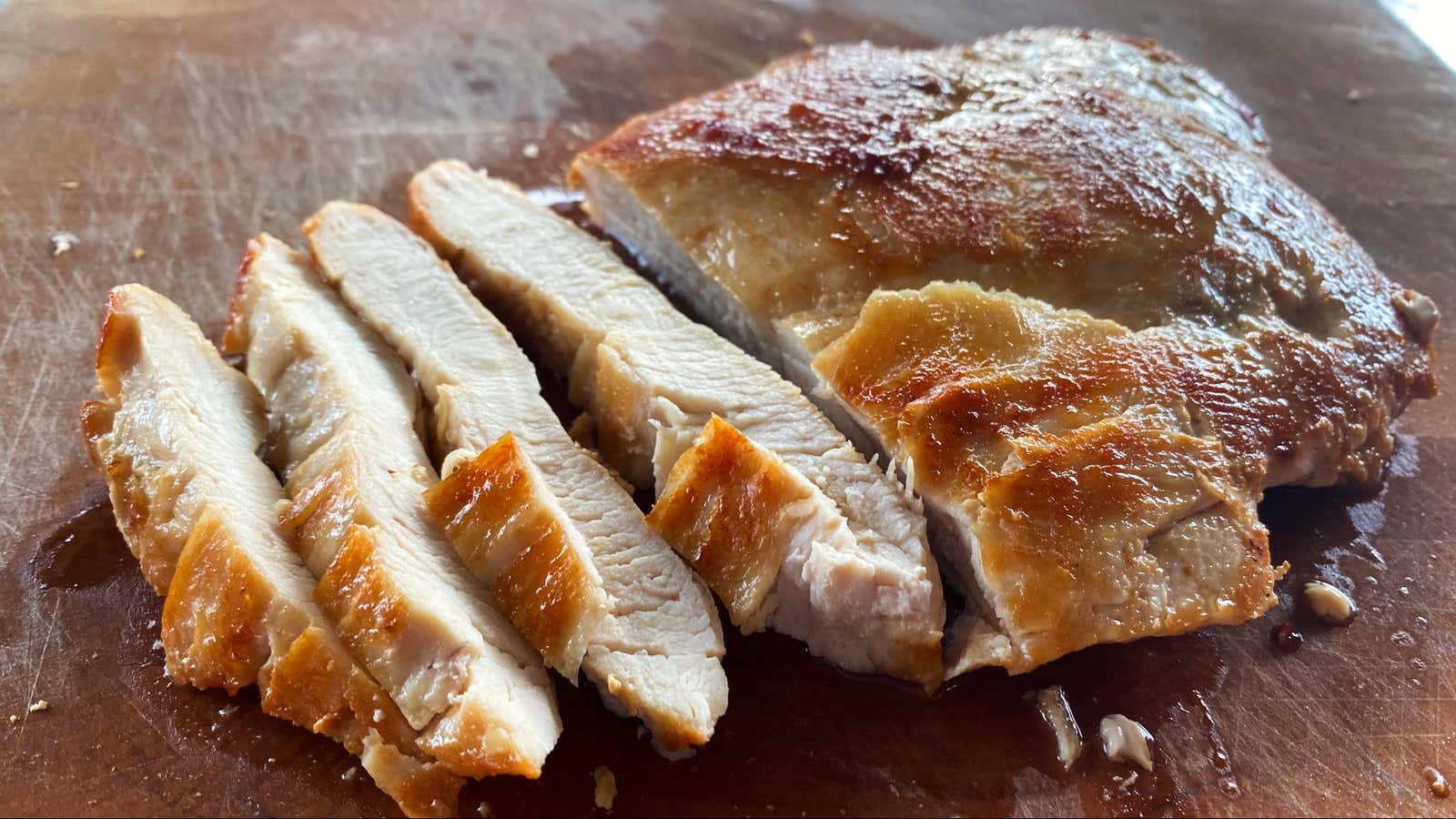
Photo: Claire Lower
The combination of chest freezer and vacuum sealer is a powerful one. As someone who needs to eat a lot of protein (because of the powerlifting) and hates repeat meals (because I’m a finicky little baby), being able to buy meat in bulk and freeze it has helped me cut down on takeout. Chicken, steak, pork, shrimp—it’s all in my freezer, waiting to satisfy my whims and cravings.
I’ve even got some chicken breasts in there. I’m usually not too big on white meat—I’m more of a thigh guy—but I do love a thin, pounded-out piece of breast meat, browned and crisped in a pan. As I’ve mentioned previously (over five years ago!), there are many advantages to taking out some aggression on a chicken breast, transforming its lopsided, teardrop shape into something thin and uniform:
Pounding a chicken breast is quite easy, and it has a many advantages. A piece of meat with a uniform thickness is going to cook much more evenly, and a thinner piece of meat is going to cook much more quickly. You’re also mechanically tenderizing the meat, which is kind of like a mamma bird pre-chewing baby bird’s food, only much less gross. This means you’re going to get juicier, tastier chicken on the table faster, which is the best of all possible outcomes. (Also, flatter chicken makes for better chicken sandwiches, and chicken sandwiches are very important.)
Pounding out a frozen chicken breast is difficult, however, which is why I take a mallet to mine before I freeze them. It eliminates an extra step when I go to cook it, and it freezes and thaws more evenly and quickly.
How to pound out a chicken breast
To pound out a chicken breast, you’ll need to wrap it in plastic. This prevents the raw chicken juices from flying around. Some people use plastic wrap, but I prefer a sealable freezer bag because it’s made of tougher stuff that’s less likely to tear, and you can close it up.
G/O Media may get a commission
Up to $100 credit
Samsung Reserve
Reserve the next gen Samsung device All you need to do is sign up with your email and boom: credit for your preorder on a new Samsung device.
Trim the meat of any white stringy bits and excess fat, and place your lopsided chicken breast in a gallon-sized freezer bag. Grab a heavy, blunt object—I use a metal soup ladle but a skillet or sauce pan works well too—and whack it, starting from the thickest part of the breast and working your way outward, flipping as needed to get it as even and thin as you can without tearing the meat. Aim for a 3/4-inch thickness.
How to freeze a chicken breast
If you have a vacuum sealer, use that. If you don’t have a vacuum sealer, wrap each breast in a piece of plastic wrap, then place them in a gallon-sized freezer bag. When you’re ready to eat it, transfer to the fridge to thaw, either on its own or in a marinade.
How to cook a chicken breast from frozen
These methods can be used on any frozen chicken (pounded or not) but you can pan fry a flattened breast directly from frozen. Doing this to an un-pounded, teardrop-shaped breast would be folly—it would take forever for the thickest part to reach a safe temperature and would dry out in the process—but a thin, even breast will thaw and cook in the pan much more quickly, all while developing a lovely crust. Just make sure to keep your heat around medium-low (especially if you’re working with an extra hot electric range), otherwise you might end up with a burnt exterior and too-pink interior.
Add enough fat to coat the bottom of a stainless steel pan (or use a very well-seasoned cast iron), then salt both sides of the breast by sprinkling one side with salt and letting it sit for about 30 seconds, then flipping and repeating on the other side. Add the meat to the prepared pan set over medium-low heat. Let cook undisturbed on one side until the edges look quite browned, then flip. Add some butter to the pan and baste the breast while the other side browns, then remove once it registers 155℉ on a digital thermometer at the thickest part (which shouldn’t be much thicker than the rest of it, thanks to your pre-pounding).
I recently watched “ the greatest film of all time ,” and the most boring one. In retrospect, the title alone should have been a sufficient warning: Jeanne Dielman, 23 Quai du Commerce, 1080 Bruxelles . Alas, I’m old enough to be a bit nostalgic about massive telephone address books. And massive it is. Clocking over 200 minutes, Chantal Akerman's 1975 dreary drama follows three days in the monotonous routine of Jeanne, a widow, a mother, and a prostitute. I watched Jeanne’s autopilot existence, until, staring at her back as she washes dishes, I decided to fast-forward a couple of minutes, only to discover she was still at it. And Jeanne is equally thorough when she’s busy baking, cleaning, folding laundry, or shining her son’s shoes. She speaks so scarcely and mechanically, that it’s impossible to detect any emotion or volition beyond her carefully controlled chores . Watching Jeanne Dielman is what the word “painstaking” was invented for. Chantal...
Stored procedures: like functions for your SQL. A stored procedure is a batch of SQL statements created and stored on a database. You can reuse a stored procedure over and over again. A stored procedure can accept parameters, run a query, and return results. Many users can call a stored procedure and different applications can call it with different parameter values. What Are the Benefits of Using Stored Procedures? Apart from allowing multiple users and applications to reuse it, a stored procedure has other benefits. It is easy to modify. You can change a stored procedure when necessary and these updates will be reflected for all users. Furthermore, you don’t need to redeploy your application when you modify the stored procedure. It reduces network traffic because the server only passes the procedure’s name over the network and not the entire query. It improves database security since users don’t have direct access to tables. To make...
Believe it or not, a Christmas tree won't stay upright on its own. Instead, you need a stable Christmas tree stand that can accommodate the type and size of tree you have. We researched dozens of the best Christmas tree stands to help you find the right one for your needs, whether you have a real tree, an artificial tree, a small tree, or a behemoth. The stands in our guide have a track record of durability, performance, and easy setup. We also outline the size and type of tree each stand is meant for. Check out our guide to the best Christmas tree skirts once you've chosen the right stand for your tree. The best Christmas tree stands in 2022 Best Christmas tree stand overall: Krinner Tree Genie Christmas Tree Stand, available at Amazon, $82.79 The German-engineered Krinner Tree Genie Christmas Tree Stand is easy to set up in a couple of minutes and keeps trees up to 12 f...





Comments
Post a Comment