Believe it or not, a Christmas tree won't stay upright on its own. Instead, you need a stable Christmas tree stand that can accommodate the type and size of tree you have. We researched dozens of the best Christmas tree stands to help you find the right one for your needs, whether you have a real tree, an artificial tree, a small tree, or a behemoth. The stands in our guide have a track record of durability, performance, and easy setup. We also outline the size and type of tree each stand is meant for. Check out our guide to the best Christmas tree skirts once you've chosen the right stand for your tree. The best Christmas tree stands in 2022 Best Christmas tree stand overall: Krinner Tree Genie Christmas Tree Stand, available at Amazon, $82.79 The German-engineered Krinner Tree Genie Christmas Tree Stand is easy to set up in a couple of minutes and keeps trees up to 12 f...
Get link
Facebook
X
Pinterest
Email
Other Apps
How to Spot the International Space Station in the Sky
Get link
Facebook
X
Pinterest
Email
Other Apps
Photo: Darryl Fonseka (Shutterstock)
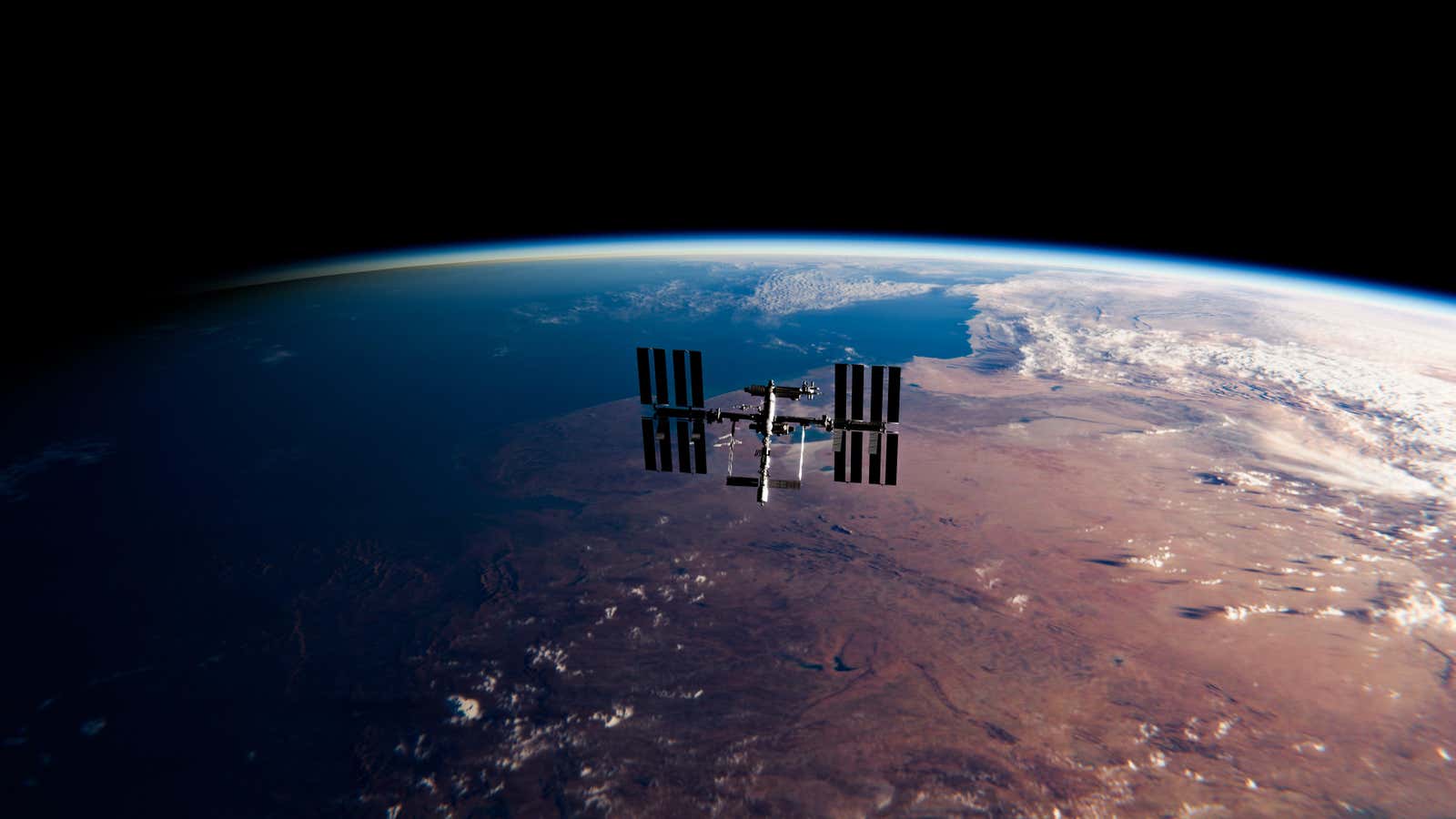
If you’ve ever looked up at the lights in the nighttime sky and wondered if there’s life up there, rest assured that there is. The third brightest object in the heavens is the International Space Station where seven people currently reside: three NASA astronauts, one person from the European Space Agency, and three Russian cosmonauts. Spotting the ISS in its orbit is easy too—if you know where (and when) to look. The ISS isn’t the only spacecraft orbiting Earth either. There are thousands, and many are large enough and low enough to see with the naked eye.
How to spot the International Space Station
The ISS is the easiest manmade object to spot in the nighttime sky. The thing is huge—about the size of a football field—and it reflects enough sunlight to appear 16 times brighter than the North Star if conditions are right. It orbits the Earth every 90 minutes too, so you can probably see it within the next few days.
Because of the station’s orbit, you can only see it soon after or before sunset in the continental United States. It appears low in the sky, close to the horizon, and looks like a fast-moving airplane, except without blinking lights. It doesn’t “twinkle” like a star either—just a relatively fast-moving light.
To facilitate your satellite peeping, NASA maintains Spot the Station, a location-based site that will tell you exactly when to look up to see the space station. Visit the site, enter your hometown, and mark your calendar for the ISS’s next appearance.
G/O Media may get a commission
Up to $100 credit
Samsung Reserve
Reserve the next gen Samsung device All you need to do is sign up with your email and boom: credit for your preorder on a new Samsung device.
Like any star-gazing, for the best experience, find as dark a location as possible, douse all sources of light for about half an hour to give your eyes a chance to adjust, and look at the part of the sky NASA recommends. You don’t need a telescope or binoculars to see the ISS, but I highly recommend using either: It’s very cool to see the actual shape of the satellite.
How to spot StarLink Satellites
No matter how you feel about Elon Musk, his armada of thousands of satellites looks pretty cool in the night sky. The internet-providing Starlink satellites from SpaceX appear as a train of lights that many have mistaken for UFOs.
They are in a very low orbit, but they’re not huge, so they can be a little harder to spot than the ISS. When you can see them depends on where you are and the cloud cover, obviously, but this site uses your exact location to tell you when the next (hopefully visible) Starlink chain will pass over, and uses Google’s Street View to show you exactly where to look in the sky. You can even schedule a reminder so you don’t miss it.
Believe it or not, a Christmas tree won't stay upright on its own. Instead, you need a stable Christmas tree stand that can accommodate the type and size of tree you have. We researched dozens of the best Christmas tree stands to help you find the right one for your needs, whether you have a real tree, an artificial tree, a small tree, or a behemoth. The stands in our guide have a track record of durability, performance, and easy setup. We also outline the size and type of tree each stand is meant for. Check out our guide to the best Christmas tree skirts once you've chosen the right stand for your tree. The best Christmas tree stands in 2022 Best Christmas tree stand overall: Krinner Tree Genie Christmas Tree Stand, available at Amazon, $82.79 The German-engineered Krinner Tree Genie Christmas Tree Stand is easy to set up in a couple of minutes and keeps trees up to 12 f...
Stored procedures: like functions for your SQL. A stored procedure is a batch of SQL statements created and stored on a database. You can reuse a stored procedure over and over again. A stored procedure can accept parameters, run a query, and return results. Many users can call a stored procedure and different applications can call it with different parameter values. What Are the Benefits of Using Stored Procedures? Apart from allowing multiple users and applications to reuse it, a stored procedure has other benefits. It is easy to modify. You can change a stored procedure when necessary and these updates will be reflected for all users. Furthermore, you don’t need to redeploy your application when you modify the stored procedure. It reduces network traffic because the server only passes the procedure’s name over the network and not the entire query. It improves database security since users don’t have direct access to tables. To make...
I recently watched “ the greatest film of all time ,” and the most boring one. In retrospect, the title alone should have been a sufficient warning: Jeanne Dielman, 23 Quai du Commerce, 1080 Bruxelles . Alas, I’m old enough to be a bit nostalgic about massive telephone address books. And massive it is. Clocking over 200 minutes, Chantal Akerman's 1975 dreary drama follows three days in the monotonous routine of Jeanne, a widow, a mother, and a prostitute. I watched Jeanne’s autopilot existence, until, staring at her back as she washes dishes, I decided to fast-forward a couple of minutes, only to discover she was still at it. And Jeanne is equally thorough when she’s busy baking, cleaning, folding laundry, or shining her son’s shoes. She speaks so scarcely and mechanically, that it’s impossible to detect any emotion or volition beyond her carefully controlled chores . Watching Jeanne Dielman is what the word “painstaking” was invented for. Chantal...





Comments
Post a Comment